In this article8 sections
TL;DR
- Most AEO tools tell you whether ChatGPT, Perplexity, Gemini and Google AI name you. Fewer fix pages or earn the outside mentions those engines cite.
- Judge any tool with one question: does it tell you the score, or change the score?
- A tracker alone is enough only when someone already does the work.
- Compared below: HubSpot AEO, Geoptie, Airefs, AirOps and Ranla.
- Ranla ships pages, fixes and tracking as pull requests you review, drafts replies to the Reddit threads engines cite, and shows what each piece earned. It starts free.
What an answer engine optimization tool should do
Answer engine optimization (AEO) is the work of getting your product named and cited inside AI-generated answers. A buyer asks "what's the best invoicing tool for a two-person agency" and the engine replies with three names. AEO decides whether yours is one of them.
That work breaks into five jobs, and a useful tool covers more than the first:
- Check the answers. Run the questions your buyers ask across ChatGPT, Perplexity, Gemini and Google AI Overviews. Record who gets named, how you are described, and which URLs are cited.
- Find the sources behind them. Engines build answers from pages they trust: your site, review sites, comparison lists, Reddit threads. The cited URLs tell you where to work.
- Fix and write your own pages. If an engine cites a competitor's comparison page and you have none, that is a page to write. If your pricing page is vague, that is a fix.
- Earn a place in outside sources. Get listed on the lists engines cite, and answer the threads they pull from with something useful.
- Prove it worked. Tie the work to signups and payments, not just to a visibility score.
Most tools on the market are strongest at job 1. Jobs 3 through 5 are where small teams stall.
The four kinds of AEO tool
"AEO tool" covers four different jobs. There are tracking tools that show whether engines cite you, content optimization tools that help structure pages engines pull from, graders that give a one-time score and a fix list, and AEO modules inside an SEO suite you may already pay for. Decide which job you need before comparing features.
What those four leave out is jobs 4 and 5 above: earning outside sources and proving results. Airefs's homepage puts the case for outside sources plainly. It says 39% of AI sources are blog posts, 35% come from Reddit and Quora, and 95% are from third-party websites. Whatever the exact share in your category, the direction is clear: your own site is only part of what an engine reads. A tool that only watches your site and your score is watching a minority of the inputs.
So sort tools by one question: does it tell you the score, or does it change the score?
When a tracker is enough, and when it is not
A tracker alone is the right buy when:
- You already have someone who writes pages, fixes the site and answers threads, and they need a scoreboard.
- You only need to answer "are we showing up?" for a board update or a one-time audit.
- You track a handful of prompts, and checking them weekly is all the attention AEO gets.
A tracker alone is the wrong buy when:
- Nobody on the team owns search. The dashboard will report the same gaps every week.
- You cannot connect a visibility change to a signup, because signup and payment events are not tracked in the first place.
- The engines in your category mostly cite outside sources, and the tool gives you no way to work on them.
The other options each trade something. Hiring a growth person gets you an owner but costs a salary and a ramp. A done-for-you SEO or AEO agency does the work but you see it secondhand and it is hard to tie to revenue. Stitching a tracker, a writing tool and a spreadsheet together works until the person stitching it gets busy.
Your first week of AEO work, by hand
Run this before you pay for anything. It tells you how big the job is and what you need a tool to do.
Day 1: List the questions. Write 15 to 25 questions a buyer would ask an AI before choosing a tool like yours. Use the words your customers use on sales calls and in support tickets, not your homepage copy. Include "best X for Y", "X vs Y", "alternatives to Y" and "how do I do Z".
Day 2: Run them. Ask each question in ChatGPT, Perplexity, Gemini and Google (for the AI Overview). In a sheet, record: were you named, who was named instead, how you were described, and every URL cited.
Day 3: Check your tracking. Open your analytics and confirm that signup, activation and first payment fire as events. If they do not, fix that before any page work, or you will never know what the page earned.
Day 4: Fix one page. Pick the gap that shows up most. Often it is a comparison or "alternatives" page that engines cite for a competitor while you have nothing. Write the honest version, with real prices and real trade-offs.
Day 5: Work one outside source. Find two cited threads or lists. On a list, ask to be included. On a thread, write a reply that answers the question fully on its own, and say plainly that you work on the product if you mention it. A reply that is only a pitch does nothing for the thread or for the engines reading it.
At the end of the week you know three things: how often you are named, which outside sources matter in your category, and whether you can measure a result. Those three answers decide which tool you need.
How to choose an AEO tool
Decide what you are measuring first. "Similar results" means nothing until you name the result. Mentions? Citations of your URLs? Signups from AI referrals? Pick one goal and judge every tool against it.
Start with fewer prompts. A small SaaS team rarely needs hundreds of tracked prompts. Twenty to fifty real buyer questions cover most categories. Pay for more only once you are acting on the first set.
Do not confuse a link score with search visibility. Domain rating style scores measure link popularity, not whether Google shows you. Search Console impressions tell you whether Google is indexing and showing your pages at all. Check those before worrying about AI answers.
Ask what happens after the score. Does the tool write or fix pages, or hand you a list? Does it work on outside sources? Who reviews changes before they reach your site?
Ask how it proves results. If the tool cannot connect its work to a goal you track, you are paying for a report.
AEO tools compared
Each row below is drawn from that tool's own site.
| Tool | Built for | What it tracks | What it does about the gaps |
|---|---|---|---|
| HubSpot AEO | Part of HubSpot's customer platform, in beta | Your brand across ChatGPT, Gemini and Perplexity | HubSpot's AEO page says it "tells you exactly what to fix" |
| Geoptie | Brands and agencies, going by the client logos on its homepage | Visibility across ChatGPT, Claude, Perplexity, Gemini, Copilot, Grok and Google AI Overviews, with a rank tracker, competitor view and the sources engines cite | A GEO audit, a content checker and a keyword finder that point to what to change; a demo is the main way in |
| Airefs | Startups, agencies and local businesses | Prompt tracking, share of voice, AI crawler analytics and AI traffic analytics | Writes articles to publish on your site, finds Reddit, Quora and LinkedIn discussions and drafts comments, finds third-party articles AI cites and drafts outreach; also offers a done-for-you service |
| AirOps | Brands that want a strategy team plus a platform | Your market share with the buyers that matter, against competitors | A platform of agents that research, publish and refresh content, with a hands-on strategy team; its homepage says it ties every move back to pipeline and revenue |
| Ranla | SaaS teams with a product, a repo and no growth hire | What ChatGPT, Perplexity, Gemini and Google AI say about you, and the outside sources they cite | Ships pages, fixes and tracking as pull requests you review, drafts Reddit replies you approve, and shows what each piece earned |
On price, HubSpot's AEO page lists the tool at $50/month with 25 prompts included, more available to buy, and a free trial.
Where Ranla fits
Ranla is an AI growth engineer for SaaS teams that know search and AI answers matter and have nobody to do the work. It does the five jobs above end to end. The Search and AEO channel checks what ChatGPT, Perplexity, Gemini and Google AI say about you and drafts pages to fix the gaps. The Reddit work finds the threads those answers cite and drafts replies, which post only when you approve them or inside a cap you set.
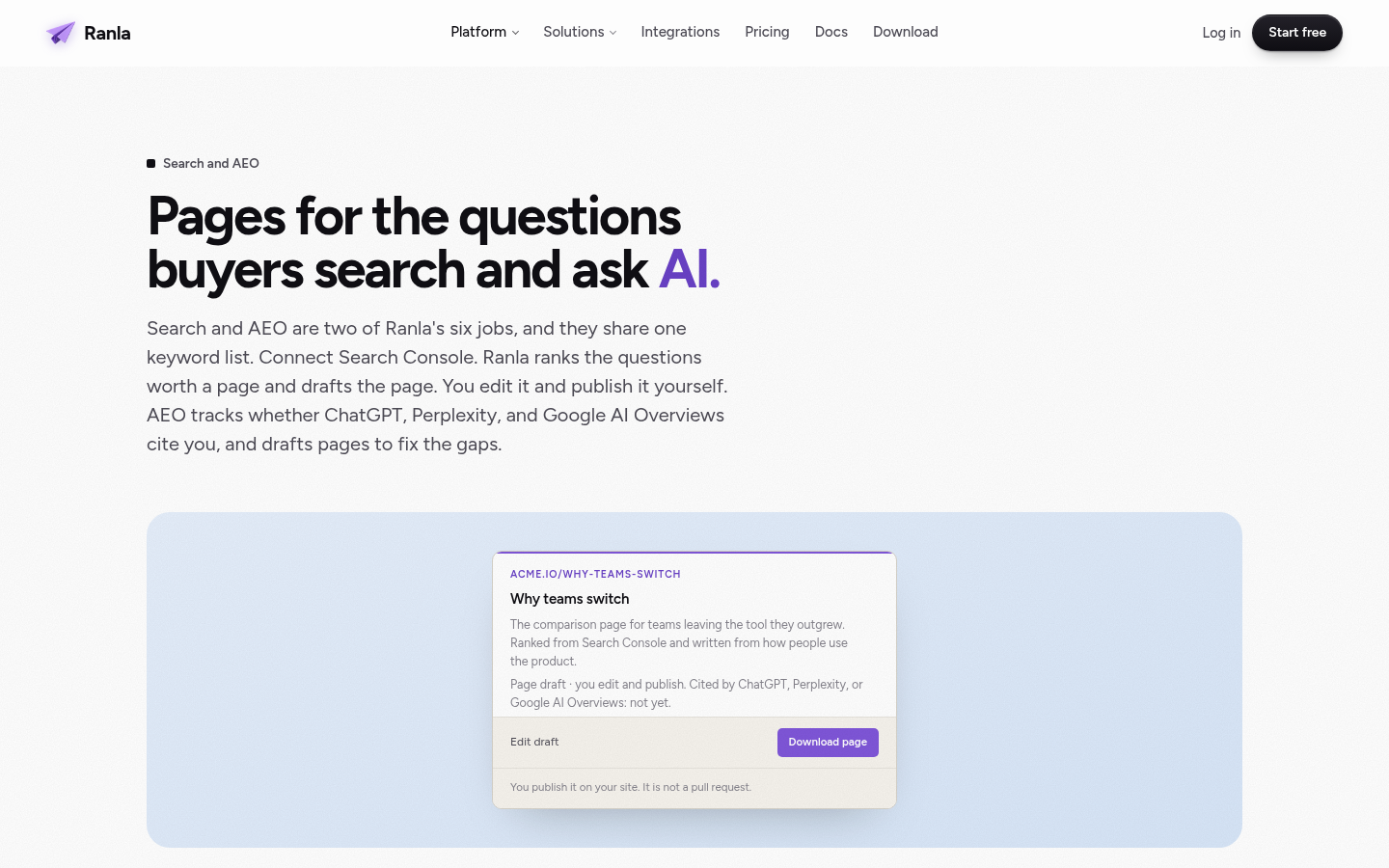
It works in four steps:
- Connect your repo, analytics and Search Console.
- Review the plan: what to rank for, which AI answers to fix, which threads matter.
- Approve the work. Pages, fixes and conversion tracking land as pull requests you review. Nothing reaches production without you.
- Read the results: what each page, fix and reply earned.
You choose how much it does alone. It can draft, propose, or run work on Autopilot inside limits you set.
Ranla starts free. See the pricing page for plans.
Every paid plan includes every feature. Autopilot and sending need a paid plan. Founding members get their first 14 days free, then 50% off Growth or above for life while their Growth in public page stays on.
If you are weighing Ranla against a hire, the AI growth engineer vs growth hire comparison walks through the trade.