In this article11 sections
There are three ways to get growth done: hire a growth marketer, hire an agency, or run an AI growth engineer. We compare them on four things: who owns instrumentation, who owns the path from signup to revenue, how the work is reviewed, and how you would know it earned anything. We also say plainly when a person or an agency is the better call.
Who this decision is for
You are a founder or a small marketing, product, or engineering team at a SaaS company. People can sign up for your product without talking to sales. You have some analytics in place, or a repo you can point at. You do not have a growth team yet, and you have budget for one of three things: a growth hire, an agency retainer, or a software line item. You want to know which one turns into revenue you can see.
If you sell through demos and a sales team, or you work in a regulated space like healthcare, the answer at the end is different, and we say so.
What we mean by the two titles
A growth marketer owns channels. Search, paid ads, email, social. They write the tracking plan, brief the designer, file the engineering ticket, and wait. They are good at deciding what to test and reading the result. They are dependent on other people to ship the test.
A growth engineer owns the same channels and also ships. They write the tracking event, build the landing page, and wire the data pipeline themselves. The value is not the code. The value is that nothing waits on a sprint.
An AI growth engineer is that second job done by software. It reads your product data and your code, drafts and runs the channel work, and ships the tracking it needs, with an engineer approving every code change. We treat it on this page as a third option next to a hire and an agency, not as a feature you bolt onto either.
The four things that decide it
Most comparisons of these roles stop at skills. You are not buying skills. You are buying an outcome, and four things determine whether you get one.
1. Who owns instrumentation
A growth team without instrumentation is guessing. Before anyone runs a campaign, someone has to define what activation and payment look like in your product and make sure those events fire. If they do not, every report that follows is a story about clicks.
A growth marketer writes a tracking plan and hands it to engineering. It ships when a sprint opens, which is often two weeks after the campaign was supposed to start. An agency asks your team for the same events, or falls back on ad-platform pixels because that is what it controls. Neither owns the job. The first job of any growth option is shipping product events and conversion tracking, and if your option cannot do that itself, budget the engineering time before you budget the campaigns.
2. Who owns the path from signup to revenue
Acquisition is the easy half to assign. The hard half starts when a signup does not activate. Whose job is the onboarding email, the in-product nudge, and the report that says which one worked? If the answer is "three people, and one of them is a contractor," the path has no owner, and the channel with the most budget will get the credit for whatever revenue shows up.
3. How work gets reviewed
A hire's landing page copy gets a glance from a founder. Their tracking request gets an engineering ticket. An agency's work gets a monthly call. For an AI agent, the review step is the safety step. Anything that touches your codebase should arrive as a pull request an engineer approves, and anything that sends or spends should run inside limits you set. An agent that pushes tracking code straight to production is not a teammate. It is a liability with an API key. If an option cannot describe its review step, it does not have one.
4. How you would know it earned anything
Opens, clicks, and impressions are activity. Lift on your goal is the outcome. The test for every option is the same: can it compare the people who got the work against a holdout who did not, and report the difference in signups, activations, or revenue? A marketing hire or tool that cannot show what it earned against a holdout is a cost, not a hire. That is true of a person, an agency, and an agent alike.
The three options side by side
| Criterion | Hire a growth marketer | Hire an agency | AI growth engineer |
|---|---|---|---|
| Who owns instrumentation | The marketer writes the plan; engineering ships it when a sprint opens | The agency asks your team, or relies on ad-platform pixels | The agent reads your repo or analytics and proposes product events and conversion tracking as pull requests |
| Who owns signup to revenue | One person, if their scope covers activation and lifecycle as well as acquisition | Usually acquisition only, scoped by the retainer | One system across search, Reddit, ads, and email, with lifecycle email on the same stack |
| How work is reviewed | Ad hoc: founder reads copy, engineering reviews tickets | Monthly reporting call | Code changes land as pull requests you review; sending and spending stay inside limits you set |
| How you know it earned anything | Depends on the person building attribution themselves | Agency reports, typically channel metrics | Lift measured with holdouts on your goal, each piece of work shown against what it earned |
| Time to first output | Weeks of recruiting, then a ramp | Onboarding and discovery first | The first tracking pull request lands about one minute after you connect a repo |
| Cost model | A salary | A retainer | Free plan with 500 credits, no card; paid plans from $99 a month |
Can one hire cover search, ads, email, and social?
This is the question founders ask in private and most role pages skip. The straight answer: yes, one person can run PPC, SEO, email, and paid social at once. It happens all the time. It is rarely a good outcome for either side.
The hire needs enough expertise in each channel to move a number there, and then needs the hours to execute in all four. The hours run out first. Weekly content for SEO alone fills a week. Add two or three paid campaigns per platform, a lifecycle email program, and a CRM nobody kept clean, and the generalist is spread too thin to move anything. The company reads the flat numbers as a hiring mistake. The hire reads the workload as a setup for failure. Both are right.
The usual fix is two people: a marketing manager and a senior SEO, with more headcount as gaps appear. That is a fine plan if you have two salaries and the patience for two ramps. If you do not, stop treating channels as separate jobs. Hand the repetitive execution to a system and keep one human on goals and review.
Option 1: Hire a growth marketer
The case for a person is judgment. A good growth marketer settles your positioning, picks the first channel, and knows when a test is noise. If your strategy is still open, no agent will close it for you.
The case against is everything in the table. The hire depends on engineering for tracking, on a designer for pages, and on a founder for review. Their first month is often spent asking for events that should have existed before they arrived. And unless they build attribution themselves, the proof of what they earned is a dashboard of channel metrics.
Option 2: Hire an agency
The case for an agency is handoff. You describe the goal, they run the channels, you read a monthly report. For a founder who wants the function off their plate, that is a real benefit.
The case against is scope and proof. Retainers are usually written around acquisition, so activation and lifecycle stay with you. Instrumentation stays with you too, because the agency does not have access to your repo. And the report is channel metrics, because that is what the agency controls. If you want to know whether the retainer earned more than it cost, you will build that measurement yourself.
Option 3: Ranla, the AI growth engineer
Ranla runs the six jobs a growth engineer would otherwise split across a hire and a stack of tools: engineering, lifecycle email, paid advertising, search, AEO, and social. It starts by reading your repo or analytics and shipping product events and conversion tracking as pull requests your engineers review. That is how it answers the first criterion before it touches a channel, and it takes about one minute from connecting a repo to the first pull request landing for review.
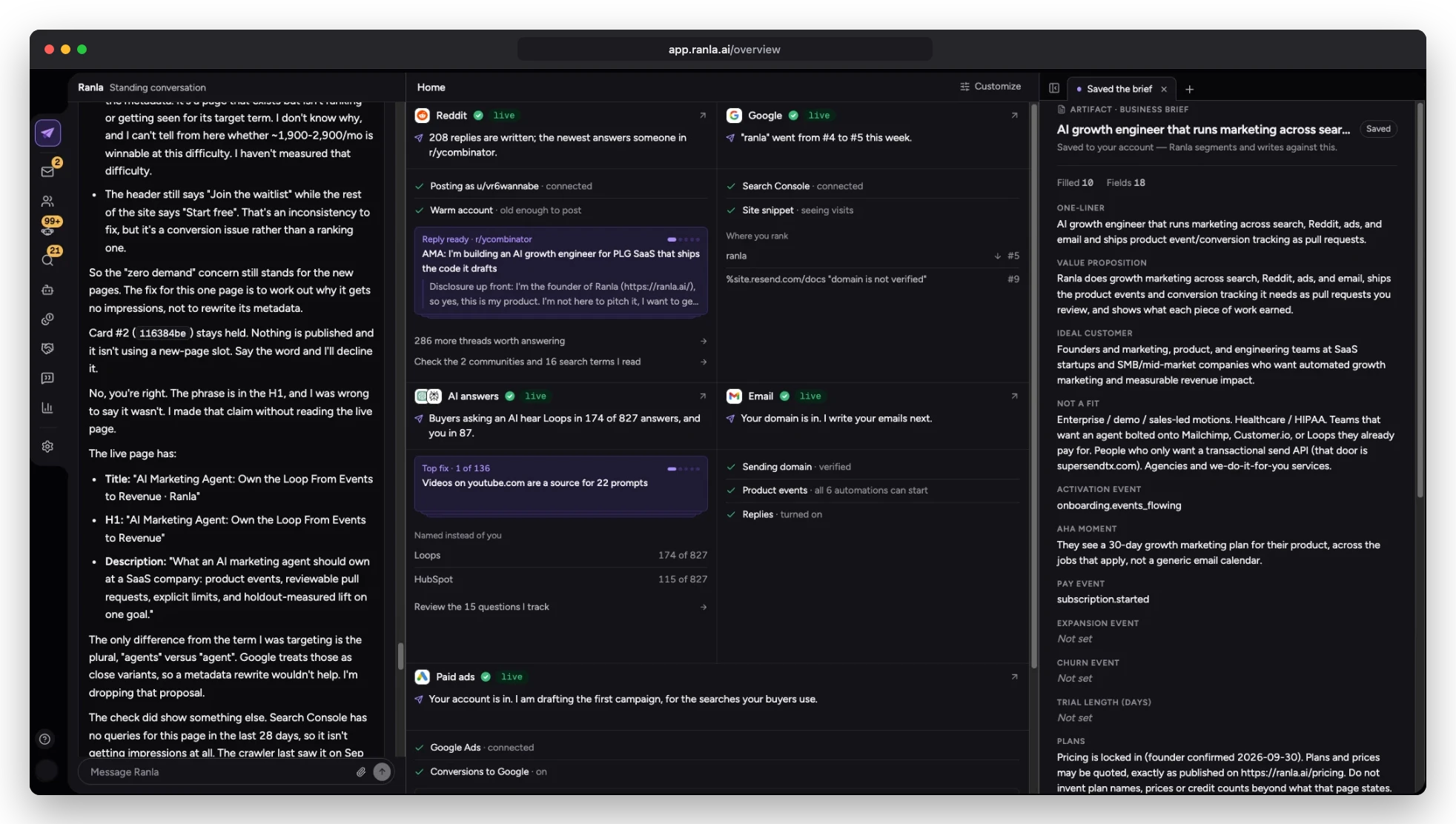
Once the events fire, Ranla drafts, proposes, or runs work inside limits you set. It refreshes search pages and checks whether ChatGPT and Perplexity mention you. It adds Google Ads keywords. It posts Reddit replies. It runs lifecycle and transactional email on the same stack. Every piece of work is measured with a holdout on your goal, so the report you read is activations or revenue against a control group, not opens and clicks. It connects to GitHub, PostHog, Amplitude, Mixpanel, Stripe, Slack, Twilio, Google Ads, Search Console, ChatGPT, Perplexity, and Reddit. We wrote up the events-to-revenue loop, pull request review, and the three modes in more depth on how the agent works.
There is a free plan, and sending campaigns and Autopilot need a paid plan. Current plans and prices are on the pricing page, linked below.
When a person or an agency is the better call
An AI growth engineer is the wrong answer in several real situations, and pretending otherwise would waste your quarter.
You sell through demos and a sales team. The work that moves revenue is pipeline, outbound, and enablement. Ranla runs self-serve growth and does not serve that motion.
You are in healthcare or another regulated space. If HIPAA or a similar regime governs your data, hire a person who owns compliance alongside growth. Ranla is not built for it.
Your strategy is unsettled. An agent runs work against a goal you set. If nobody on your team can name the goal, or your positioning is still open, a senior growth marketer earns their salary by settling those questions first. Hire them, then decide what runs the execution.
You want it done for you and do not want to review anything. Agencies exist for founders who want to hand off the whole function and get a monthly report. Ranla proposes pull requests and asks you to approve them. If you do not want that control, an agency is the honest fit.
You already have engineers eager to build growth loops into the product. If your team wants to ship referral flows and template pages themselves, a human growth engineer working alongside them may compound faster than any agent.
The pick
Hire a growth marketer when the strategy is unsettled, you sell through sales, or you are regulated. Hire an agency when you want the function handled for you and can live with channel-level reporting. Choose an AI growth engineer when you are a self-serve SaaS team with a repo and an analytics tool, you want the tracking shipped before the campaigns start, you want every code change to arrive as a pull request, and you want the report to show lift on your goal rather than opens.
For that profile, we think Ranla is a better use of one line item than a salary. You can see what it proposes on the free plan before you commit any budget.